|
By: Michael Manion |
|
|
Page Views: 5,860 |
| Hashtags: #Friction #SwedishMassage |
| All about the Friction movement of Swedish Massage. |
| Estimated reading time: 4 minute(s) (725 words) |
What is Friction?
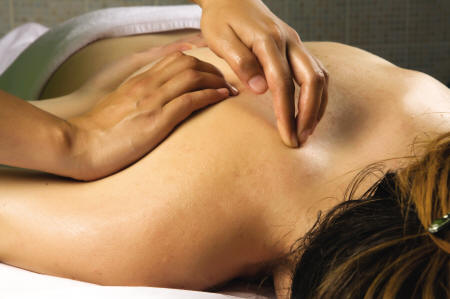
Friction accomplishes the rubbing of tissues against each other, affecting
their separation and the breakdown of inflammatory products, which can organize
and cause adhesions.
Inflammation is the body's reaction to an irritant, and can
be brought on by infection or an attack against an area of the
body by bacteria, germs or injury. Inflammation then acts to lessen
mobility, which creates a more stable environment for healing. Inflammation
thus restricts movement and lessens oxygenation to the injured area.
Adhesions can occur when inflammation and injury may have produced new tissue in order to
mend the damaged tissue. This new tissue may bind together the various muscles
or areas. In this healing process, lactic acid is exuded by the injured tissue
to repair it and because the various muscles can overlap each other, they can
become glued together by the lactic acid. In joint problems, the application of
friction is undaunted and unparalleled in its importance, especially to prevent
adhesions and therefore stiffness of the joints. Also, after adhesions have been
formed, it can assist in breaking them up and returning range of motion to the
area as well as much needed oxygen and blood.
The Best Applications for Friction
So, friction works well on various inflamed joint diseases and swollen
muscles of all kinds. The rubbing action brings much-needed blood, and the
muscles can become looser and more mobile. This is the stroke that can best
break up adhesions and allow the restoration of a full range of motion. In the case of
hard-resistant scars, massage using transverse friction with oil is best
advised.
Friction can be useful in the case of fractures of the bones of the body.
Although we would not want to see this performed while the bone is mending, it can be
helpful in small amounts if the area is in a cast. In this case, light friction
above and below the fracture helps to stimulate the absorption of the products of
stasis. After the cast is removed, light friction on the affected area can be
applied with care.
Friction can be added to the treatment of sprains as soon as harder pressure
can be applied. The greatest value of friction for sprains is where stiffness of
joints is involved. Chronic synovitis is inflammation due to repeated injury to
the synovial joints of the body. We can apply deep friction along with
other methods to alleviate some of the inflammation.
Friction is also useful with many of the foot deformities such as
flat-foot, where we apply deep friction over the tendon sheaths, the tarsal and
ankle joints and the soft tissue of the foot. A nerve massage can be given which
includes nerve friction. This applies to many nerve lesions such as neuralgia
and neuritis. In these cases, we want to perform friction, with other methods
of massage, over the nerve trunk involved and its area of distribution. This
must not be given with too much force. We also want to massage the adhesions
from the muscle inflammation that is irritating the nerve.
Sciatica is the most common of the neuritis-type conditions. The condition may be
caused by diseases in that area of the back and hip, or simply from poor posture. Friction around
the sacrum, taking care near the trunk of the sciatic nerve, can reduce
adhesions and inflammation.
Friction can relieve headaches caused by rheumatic
conditions by its use in massaging the neck
and shoulders. Lower back pain caused by conditions such as lumbago or the
lumbar region of the back may involve myositis-- inflamed muscles or
neuralgia--inflamed nerves. Treatment is very specific and includes other
massage methods along with friction along the vertebral column to alleviate
swelling and inflammation.
These are just some of the many wonderful and pain-relieving benefits to be
experienced through the use of friction.