|
By: Michael Manion |
|
|
Page Views: 2,972 |
| Hashtags: #Herbs #Datura |
| All about Datura. |
| Estimated reading time: 9 minute(s) (1914 words) |
What Are Violets?
Legend has it that the god, Zeus, changed his beloved Io into a white heifer
for fear that his wife, Hera, would find her unleash her wrath upon her. So he
caused these flowers to spring up as food for Io and he gave them her name.
Another derivation of the word "violet" comes from the word Vias,
meaning "wayside".
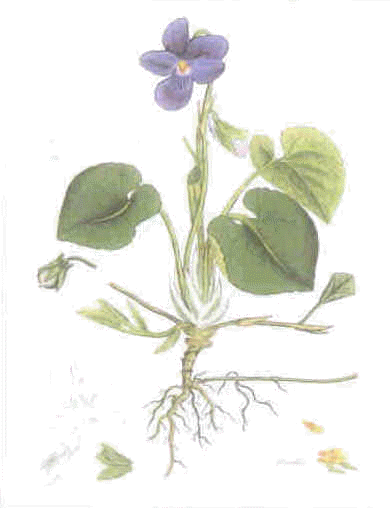
Violets are characterized by heart-shaped leaves that are slightly downy,
particularly
 underneath
the leaves. The stalks grow up from a creeping rhizome or underground stem. The
young leaves are rolled up from the ends toward the middle of the stem. The
flowing stalks grow from the axils of the leaves where they meet the root and
bear single flowers. The flowers are generally deep purple, giving their name to
the color we also call "violet". However, they can vary in color,
ranging from lilac to a pale-rose color. There are even white violets, and some
with mixed colors.
underneath
the leaves. The stalks grow up from a creeping rhizome or underground stem. The
young leaves are rolled up from the ends toward the middle of the stem. The
flowing stalks grow from the axils of the leaves where they meet the root and
bear single flowers. The flowers are generally deep purple, giving their name to
the color we also call "violet". However, they can vary in color,
ranging from lilac to a pale-rose color. There are even white violets, and some
with mixed colors.
The flowers of the violet possess five unequally shaped and sized petals.
Their flowers are filled with nectar and are constructed for bee visitations
though the season of their blooming occurs before bees come out in full array.
Perhaps they are some of the first flowering plants that insects and bees visit
each year. Some butterflies feed exclusively upon violets. The violet blooms in
spring with fragrant, larger, sweet flowers than when they bloom in the autumn
with smaller flowers that are closer to the root and actually have seeds. This
form of plant is called cleistogamous or self-fertilizing. The plant
propagates by throwing off runners and scions. Thus it is a perennial that
multiples through root growth.
The biochemical components of this plant are Saponins, methyl salicylate
alkaloid(ororatine), volatile oil, flavonoids, phenolic glycosides and mucilage.
Growing and Cultivating Hints
Violets thrive in rich, moist soil. They
usually need protection from hot afternoon sun, and in the dessert and other
hot-summer climates they should be planted in full shade. In cool-summer
climates they will grow well in full sun or sun-filtered shade. Though they are
considered a perennial they are usually treated as an annual and can be started
from seed. Violets spread by runners and can be divided to form new separate
plants. The plants can reach any where from 6 to 12 inches in height. As a
boarder plant in your garden when planted under spring flowering bulbs, they
will provide mass color as a ground cover. If you fertilize sweet violets in the
spring before they bloom, they will produce more flowers.
The best times of the year to collect fresh violet plant material is in the
spring. The best months for collection or gathering are during March and April.
These various plant parts can be divided and dried or the whole plant can be
carefully dried and preserved. Parts can be divided as used as needed.
Medical uses for Violets
The Violet Flower
The Violet flower possesses strong laxative properties. They are
most widely used as an expectorant. The best form that has been sited of
administering the flowers is in Syrup of Violets. This is used to treat
respiratory conditions and can be given to children as well. Violet flowers are
known to have a sedative affect and are helpful for anxiety, hangovers,
headaches, migraines and insomnia.
The Leaves of the Violet Plant
The leaves contain certain glucosidal
principles and are best used as an antiseptic. The more potent green leaves can
be applied to teas and ointments alike and work wonders with cancers
specifically the mouth and throat, and combined with other herbs for treating
inflammations, swellings and pains arising from heat and for piles. Applied
externally they soften hard cancerous masses such as tumors or treat cracked
nipples, extreme skin conditions or eczema. The fresh leaves and flowers can be
used as a poultice over a period of time and have been reported to have a
marvelous remedy and even cure for a variety of cancers. The best results for
this has been to use freshly cut leaves in fresh boiled water for twelve hours.
They are useful in spasmodic coughs accompanied by heavy breathing, sore throats
and rheumatism of the wrists.
The Rootstocks of the Violet
In large doses are used as an emetic and has been known to be used in place of ipecacuanha.
The Seeds of the Violet
These can cause vomiting and in the correct proportions can be used
as for their purgative qualities.
Formulas for Treatment
For treating a variety of complaints as mentioned
earlier, gather or chop together a handful of violet leaves and flowers into
half a pint of water, steep for half an hour and administer 2 to 3 tablespoons
every 2 to 3 hours. You can add more herbs if you are an adult. This is s good
remedy for children.
Doses for using violet should include one part flower to 100 parts of water
for a Syrup in should include 30 to 50 grains, when putting together an emetic
the doses should be 40 to 50 grains of the plants flowers.
A conserve of violets cools and breaks up a fever. To put this together mash
1 lb. of violets either freshly cut or dried and add the juice of one freshly
squeezed lemon and 1 tablespoon of rose water if they are to dry. When
thoroughly mashed add 3 lbs. of sugar or its equivalent in honey as a
preservative. Make sure this is mixed together well. You can place this in
sterilized glass jars that are tightly sealed like you would a jam or you can
simmer it gently for a few minutes on a low setting upon your stove and then
place this in a jar in the same way. For immediate use for fever or inflammation
dissolve this conserve in almond milk. It works well with children when they are
feverish and for any aches and pains.
The leaves and flowers act as an antiseptic when applied directly to the skin
or an area of the body that has been wounded, cut, scraped or burned. An
infusion made as suggested below under the section Whole Plant Remedies. This
can be drunk 3 times a day as a remedy for the above. A tincture of violet can
be taken, if you prefer, of 1 to 2 ml, 3 times a daily.
An eyewash can be made from the crushed leaves of this plant. Mash up 1 lb.
of fresh cut leaves and boil together in 3 cups of sterilized water until water
turns a deep color. Strain plant leaves and save the liquid. The plant leaves
can be used as a poultice or compote. Cool the liquid and apply to the eyes.
Whole Plant Remedies
The whole pant makes a good mouthwash or gargle for inflamed gums or throat.
Extract the necessary properties by way of making an infusion using the whole
plant. Pour a cup of boiling water onto one teaspoon of the herb and allow to
infuse for 10 to 15 minutes. Strain the liquid and wash your mouth out or gargle
as usual.
P'u-fu Ching (Creeping Violet) (Viola Diffusa Ging)
This variety is mentioned
in Chinese remedies. Other names for this plant are yellow-flower grass, yellow
ground grass and courtyard grass to name a few. It has elliptical leaves with
small white or purplish flowers. Its properties are cooling with a bitter and
acid taste. It can detoxify and nourish the blood and aids in tissue
regeneration.
It is most used for aplastic anemia, leukemia, mastitis, mumps, ginseng (Pinellia ternate) poisoning, poisonous snakebites, traumatic injuries,
boils and abscesses. The suggested use for this plant is to take the whole plant
in measurements of 31.2 to 62.4 gm each time and use this in a decoction or the
fresh plant may be crushed and applied externally when needed.
Tzu-hua Ti-ting (Viola Japonica Langsd)
Another variety mentioned in Chinese
remedies, another name for this plant are arrowhead grass. This is due to the
fact that the leaves of this plant resemble arrowheads. In spring and summer
purplish-red flowers appear. The properties of this pant are cold and slightly
bitter to the taste. It helps reduce inflammation and detoxifies, cools the
blood and alleviates pain.
The conditions that can be treated with this plant are boils, ulcers,
abscesses, acute conjunctivitis, laryngitis, acute jaundice and hepatitis and
various kinds of poisonings such as mentioned earlier. The whole plant is
employed here in amounts of 15.60 gm with 3.12 gm for each dosage. This is used
in a decoction. This special preparation of the whole plant can be administer to
treat lung and chest troubles as an expectorant and specifically for the
treatment of chronic catarrhal accumulations.
Other uses for Violet
The Odor of Violets
This is called Viola odorata, familiarly called sweet
violet. It is cultivated, in many places and has been in many times, for its
perfume. When inhaled, violet is said to ease many of the pains associated with
various types of headaches. Many of these may be caused by lack of sleep or even
lack of proper amounts of oxygen.
The Violet Flower
The main chemical components of the flowers are their
odorous nature and their blue coloring. For culinary uses violets are used in
food coloring and flavoring of foods. These colorings may be extracted from
their petals by way of an infusion with boiling water. Their properties can be
preserved for some time by mixing the infusion with honey or sugar. For coloring
it can turn greener during the process when mixed with an alkaloid compound it
can turn yellow and turn more reddish with the introduction of acid compounds.
Potpourri with Violets
These flowers can be used in combination with other
scented flowers to make wonderful scented pillows and sachets. Leave a bowl of
fresh violet flowers in your bathroom or sprinkle them in your bath for a
scented pleasure or just as a romantic gesture.
The Language of Color and Fragrance
Over time we have given meaning and
thought provoking qualities to various scented flowers and their colors. For the
violet, the blue or more purple varieties of the aromatic violet evoke a sense
of faithfulness while the more aromatic white varieties conjure a sense of
modesty. Giving others these flowers has come to indicate these qualities are
inherent. It has been said that to give someone these in reverse position, by
the stems, reserves the meaning to its opposite.